

 Facebook
 X
X
 Pinterest
 Copy Link
Before we talk about equity, we need to talk about assets.
An asset is something with economic value that you own or have an ownership interest in.
That can sound much more sophisticated than it really is.
A comic book can be an asset.
A piece of jewelry can be an asset.
A collectible can be an asset.
That Ken Griffey Jr. baseball card you had as a kid and somehow let escape your grasp?
Asset. 😆
I’ve had a few of those moments myself.
Things get lost. Collections get sold. Cars eventually make their way to the junkyard. Sometimes we don’t even recognize that something has value until long after it has left our possession.
A house is interesting because ownership is formally documented.
Real property can be conveyed by deed from one owner to another and, potentially, from one generation to the next.
Assuming, of course, we manage to keep it from the bank. 😆
Because owning an interest in an asset and owning all of its value free and clear are not necessarily the same thing.
And that brings us to equity.
You May Already Understand Equity
Let’s start with something familiar.
A car.
Suppose your car is currently worth $20,000.
You have an ownership interest in an asset currently worth $20,000.
But maybe you borrowed money to buy it, and you still owe the lender $15,000.
The math looks like this:
$20,000 asset value − $15,000 debt = $5,000 equity
That’s it.
Equity isn’t a special kind of money.
It is the difference between the value of an asset and the debt secured by it.
Now imagine you continue making your car payments. Eventually, you only owe $10,000.
If the car were still worth $20,000:
$20,000 asset value − $10,000 debt = $10,000 equity
Your equity position grew.
Of course, anyone who has owned a car knows there is another side to that equation: the value can change too.
You can faithfully make payments while the car depreciates. You can even owe more than the car is worth.
That’s negative equity.
The terminology may be new.
The math probably isn’t.
Now Turn the Car Into a House
Home equity works from the same basic equation.
The numbers are bigger. The asset behaves differently. But the fundamental math remains:
Asset value − debt = equity.
Suppose a house has a current market value of $500,000 and $300,000 remains on the mortgage.
$500,000 asset value − $300,000 debt = $200,000 gross equity
That $200,000 represents an equity position in the property.
It is not necessarily $200,000 of spendable money.
There isn’t a drawer behind the water heater containing your equity. 😆
It is value held inside the asset.
And that distinction matters.
Equity Can Change From Both Directions
Our house behaves differently from the typical car.
Real estate values can rise or fall. Appreciation is never guaranteed.
At the same time, if the mortgage is being paid down, the debt against the property may also be decreasing.
So equity can change because the asset value changes, because the debt changes, or because both are happening at once.
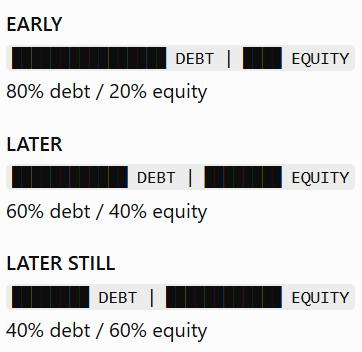
Imagine the whole property as 100%.
If debt represents 60% of its current value, the remaining 40% represents gross equity.
Over time, that relationship might become 50/50.
Later, perhaps 40% debt and 60% equity.
Or market conditions could move the equation in the opposite direction.
That’s why equity isn’t a fixed number.
It is the space between two moving numbers:
what the asset is worth and what is owed against it.
Equity Is Value. It Isn’t Cash.
This is where the conversation gets more interesting.
Start with the property’s market value—what it might reasonably sell for in the current market.
Next, consider the debt secured by the property.
The difference between those numbers is gross equity.
But gross equity isn’t necessarily the amount available to spend—or even the amount available to borrow.
From there, a lender may establish or accept a value for the property and determine how much it is willing to lend against that value.
A lender may establish or accept a value for a property and then determine how much it is willing to lend against that value. The loan product, property, existing debt, borrower qualifications and underwriting requirements can all affect that decision.
So:
Asset value is not the same as lendable value.
And:
Gross equity is not necessarily accessible equity.
You can have substantial value stored inside an asset without having the equivalent amount sitting in your bank account.
An Asset Can Have Borrowing Power
This is where our car analogy comes back.
Under the right circumstances, someone whose car is worth substantially more than the debt against it may be able to refinance a loan secured by that car.
The lender isn’t evaluating only a promise to repay. There is also an asset securing the loan.
The asset has measurable value.
Real estate can operate on a similar principle, although mortgage lending is considerably more complex.
That does not make equity free money.
Borrowing against an asset creates debt.
Interest costs money.
Loan terms matter.
And when real estate secures the debt, the real estate is collateral.
Understanding equity shouldn’t make us fearless about debt.
It should make us better informed about the choices in front of us.
So What Is Your Equity Doing?
Sometimes the wisest thing you can do with equity is absolutely nothing.
It can provide security.
It can mean lower leverage.
It can become future sale proceeds.
It can provide borrowing capacity.
It can simply offer the peace that comes from owning more and owing less.
But once we understand equity as value held inside an asset, another question becomes available:
What job do I want this equity to do?
Not:
How much can I borrow?
Those are very different questions.
Because accessing equity does not create wealth.
It creates access to capital while also creating—or restructuring—debt.
What happens next determines whether that decision ultimately creates additional value, preserves value, or destroys it.
That’s why understanding comes before action.
In my last article, Brave Enough to Investigate, we talked about using contingencies and information to investigate a property before making decisions that can be difficult or expensive to undo.
[Read: Brave Enough to Investigate ]
The same principle applies here.
We don’t need to be afraid of the tools available to us.
We need to understand them well enough to use them thoughtfully—and to know when not to use them at all.
Equity creates options.
Stewardship determines what we do with them.
And before we talk about putting equity to work, we need to understand how value held inside an asset can become usable capital.
That’s our next conversation.
Sarah Meyerdirk
Real Estate Broker
Better Homes and Gardens Real Estate Northwest Home Team
This article is for general real estate education and is not legal, tax, lending, or financial advice. Property values, loan products, qualification requirements, costs and risks vary. Questions about financing and loan options should be discussed with an appropriately licensed lending professional.


